How big is your matrix?
Sylvester rank functions
Iq Souza
Seminario de Álgebra, Geometría y Topología
Universidad Complutense de Madrid
3 de noviembre, 2026
What does rank measure?
- For a matrix A over a field \mathbb{F}: \operatorname{rk}_{\mathbb{F}}(A) = \dim_{\mathbb{F}} \operatorname{im}(A) = \text{pivots after Gaussian elim.} = \ldots
- Consider the matrix A = \begin{pmatrix}1 & 2 & 3\\ 4 & 5 & 6\\ 7 & 8 & 9\end{pmatrix} over \mathbb{Z}.
- Over \mathbb{Q}, A has rank 2.
- A \equiv \begin{pmatrix} 1 & 2 & 0\\ 1 & 2 & 0\\ 1 & 2 & 0\end{pmatrix} has rank 1 over \mathbb{F}_3.
- For all other primes, A has rank 2 over \mathbb{F}_p.
Sylvester matrix rank functions
Definition (R associative, unital ring)
- A Sylvester matrix rank function on R is a map \operatorname{rk}\colon \operatorname{Mat}(R) \to \mathbb{R}_{\geq 0} that associates to each rectangular matrix A over R a non-negative real number \operatorname{rk}(A) satisfying:
- (SMat1) \operatorname{rk}(0) = 0, \operatorname{rk}(1) = 1.
- (SMat2) \operatorname{rk}(AB) \leq \min\{\operatorname{rk}(A)\,,\operatorname{rk}(B)\}.
- (SMat3) \operatorname{rk}\begin{pmatrix}A & 0\\ 0 & B\end{pmatrix} = \operatorname{rk}(A) + \operatorname{rk}(B).
- (SMat4) \operatorname{rk}\begin{pmatrix}A & C\\ 0 & B\end{pmatrix} \geq \operatorname{rk}(A) + \operatorname{rk}(B).
- Over a field \mathbb{F}, the usual rank \operatorname{rk}_{\mathbb{F}}(A).
- Over the ring \operatorname{Mat}_{n\times n}(\mathbb{F}), \operatorname{rk}(A) = \frac{\operatorname{rk}_{\mathbb{F}}(A)}{n}.
- The previous examples come from \mathbb{Z} \to \mathbb{Q} and \mathbb{Z} \to \mathbb{F}_p.
- There is \operatorname{rk} on \mathbb{Z} with \operatorname{rk}(A) = 3/2 (foreshadowing…🕵️)
- \mathbb{P}(R): the set of all Sylvester matrix rank functions on R.
- Pointwise convergence: \operatorname{rk}_i \to \operatorname{rk} if \operatorname{rk}_i(A) \to \operatorname{rk}(A) for any matrix A.
- Compact 🥰
Laurent polynomials acting on \mathbb{C}^N
R = \mathbb{C}[t,t^{-1}]
- For each N \geq 1, map R \to \operatorname{Mat}_N(\mathbb{C}) sending t to a cyclic permutation: t \mapsto \begin{pmatrix}0 & 1 & 0 & \cdots & 0 & 0\\ 0 & 0 & 1 & \cdots & 0 & 0\\ \vdots & \vdots & \vdots & \ddots & \vdots \\ 0 & 0 & 0 & \cdots & 0 & 1 \\1 & 0 & 0 & \cdots & 0 & 0\end{pmatrix}\,.
The action on \mathbb{C}^N
- t(z_1\,,z_2\,,\ldots\,,z_N) = (z_2\,,z_3\,,\ldots\,,z_1).
- Each element of R gives a \mathbb{C}-linear map \mathbb{C}^N \to \mathbb{C}^N. Each A(t) \in \operatorname{Mat}_{n\times m}(R) gives a block matrix A_N \in \operatorname{Mat}_{nN\times mN}(\mathbb{C}).
- We have a Sylvester rank functon \operatorname{rk}_N on R by taking \operatorname{rk}_N(A(t)) = \frac{\operatorname{rk}_{\mathbb{C}} A_N}{N}\,.
- Take the 1\times 1 matrix x=t-1 over \mathbb{C}[t,t^{-1}].
- \ker x_N = \{(z_1\,,\ldots\,,z_N) \in \mathbb{C}^N\colon z_1 = z_2 = \cdots = z_N\}.
- Since \ker x_N is 1-dimensional, \operatorname{rk}_{\mathbb{C}} x_N = N-1.
- \operatorname{rk}_N(x) = \frac{N-1}{N}.
- In particular, \operatorname{rk}_N(x) \to 1 as N \to \infty. 🤔
The finite Fourier transform
Identify \mathbb{C}^N with the vector space \mathcal{P}_N all complex sequences \{a_j\}_{j\geq 0} which are N-periodic: a_j = a_{j+N} for all j \geq 0.
Fourier transform
- The sequences a_j^{(k)} = e^{\frac{2\pi ikj}{N}} for k \in \{0\,,1\,,\ldots\,,N-1\} form a basis of \mathcal{P}_N.
- In this basis, t_N is diagonal, with N eigenvalues \zeta_N^k = e^{\frac{2\pi ik}{N}}.
- \operatorname{rk}_N(A(t)) is an average over roots of unity: \operatorname{rk}_N(A(t)) = \frac{1}{N}\sum_{k=0}^{N-1} \operatorname{rk}_{\mathbb{C}} A(\zeta_N^k)\,.
Rank over the field of fractions
R = \mathbb{C}[t,t^{-1}] has a field of fractions \mathbb{C}(t), rational functions in t.
- \operatorname{rk}_{\mathbb{C}(t)}(A(t)) = j if j is the size of the largest square submatrix B(t) of A(t) such that \det B(t) \neq 0 identically.
- \det B(t) has only finitely many zeroes in \mathbb{C}^\times, say M of them. \operatorname{rk}_N(A(t)) \geq \operatorname{rk}_N(B(t)) = \frac{1}{N} \sum_{k=0}^{N-1} \operatorname{rk}_{\mathbb{C}} B(\zeta_N^k) \geq \frac{j(N-M)}{N}\,.
- \operatorname{rk}_N(A(t)) \leq j for all N since minors of size j+1 vanish identically.
- We have \operatorname{rk}_N \to \operatorname{rk}_{\mathbb{C}(t)} as N \to \infty!
The REAL Fourier transform
L^2-integrable functions on the circle
- \ell^2(\mathbb{Z}) = \left\{(a_j)_{j \in \mathbb{Z}} \colon a_j \in \mathbb{C}\,, \sum_{j \in \mathbb{Z}} |a_j|^2 < \infty\right\}\,.
- The (inverse) Fourier transform \mathcal{F}\colon \ell^2(\mathbb{Z}) \to L^2(S^1) is given by \mathcal{F}((a_j)_{j \in \mathbb{Z}}) = \sum_{j \in \mathbb{Z}} a_jz^{-j}\,.
- If T is the shift (a_j) \mapsto (a_{j+1}) in \ell^2(\mathbb{Z}), then \mathcal{F}(T(a_j)_{j \in \mathbb{Z}}) = z\mathcal{F}((a_j)_{j \in \mathbb{Z}}) corresponds to multiplication by z in L^2(S^1).
von Neumann rank
- The map t \mapsto z gives a ring map R = \mathbb{C}[t,t^{-1}] \to L^\infty(S^1).
- A matrix A(t) \in \operatorname{Mat}_{n\times m}(R) acts pointwise as matrix multiplication by A(z) on L^2(S^1)^m.
- Integration is a rank function: \operatorname{rk}_{S^1}(A(t)) = \frac{1}{2\pi} \int_0^{2\pi} \operatorname{rk}_{\mathbb{C}}(A(e^{i\theta}))d\theta\,.
- \operatorname{rk}_{\mathbb{C}(t)} = \operatorname{rk}_{S^1}!
- \lim_{N \to \infty} \operatorname{rk}_N = \operatorname{rk}_{S^1} = \operatorname{rk}_{\mathbb{C}(t)}
- \mathbb{C}[t,t^{-1}] \simeq \mathbb{C}[\mathbb{Z}]\,,\quad \mathbb{C}^N \simeq \mathbb{C}[\mathbb{Z}/N\mathbb{Z}]\,.
- So what we have really proved is an approximation statement for the group algebra of \mathbb{Z}. What about other group algebras?
Residually finite groups
Definition
- A group G is residually finite if for every 1 \neq g \in G there exists a finite index normal subgroup N \unlhd G not containing g.
- Equivalently, the intersection of all finite index normal subgroups of G is \{1\}.
Ranks from finite quotients
- The group algebra \mathbb{C}[G] = \{\sum_{g \in G} a_gg\colon a_g \in \mathbb{C}\text{, almost all }0\}.
- For N \unlhd G of finite index (G\colon N), \mathbb{C}[G/N] is finite dimensional. Each matrix A \in \operatorname{Mat}_{n\times m}(\mathbb{C}[G]) gives a matrix A_N \in \operatorname{Mat}_{n(G\colon N)\times m(G\colon N)}(\mathbb{C}).
- \operatorname{rk}_N(A) = \frac{1}{(G\colon N)} \operatorname{rk}_{\mathbb{C}}(A_N) is a Sylvester rank function.
Residually finite groups, continued
\ell^2(G)
- \ell^2(G) = \left\{\sum_{g \in G} a_gg\colon \sum_{g \in G} |a_g|^2 < \infty\right\}
- \mathbb{C}[G] acts on the left as bounded operators in \ell^2(G).
- There is a tracial *-algebra \mathcal{N}(G) with \mathbb{C}[G] \leq \mathcal{N}(G) \leq \mathcal{B}(\ell^2(G)).
- As over \mathbb{Z}, the trace of a projection in \mathcal{N}(G) gives a rank function \operatorname{rk}_{\ell^2} \in \mathbb{P}(\mathbb{C}[G]).
Lück approximation
- Let G be a residually finite group and \cdots < N_2 < N_1 < G be a chain of finite index normal subgroups with \bigcap N_i = \{1\}. Then \lim_{i \to \infty} \operatorname{rk}_{N_i} = \operatorname{rk}_{\ell^2}\,.
- W. Lück (1994) for matrices over \mathbb{Q}[G].
- Dodziuk–Linnell–Mathai–Schick–Yates (2003) for \overline{\mathbb{Q}}[G].
- A. Jaikin-Zapirain (2019) for \mathbb{C}[G].
Back to \mathbb{Z}
Ranks through \log size
- On \mathbb{Z}, we already saw \operatorname{rk}_{\mathbb{Q}} and \operatorname{rk}_{\mathbb{F}_p}.
- Fix a prime p and a positive integer k. For A \in \operatorname{Mat}(\mathbb{Z}), define \operatorname{rk}_{p^k}(A) = \frac{\log_p |\operatorname{im}(A \pmod{p^k})|}{k}\,.
- Each \operatorname{rk}_{p^k}(A) is a Sylvester matrix rank function over \mathbb{Z}.
Examples
- We have \operatorname{rk}_p = \operatorname{rk}_{\mathbb{F}_p}.
- \operatorname{rk}_9\begin{pmatrix} 1 & 2 & 3\\ 4 & 5 & 6\\ 7 & 8 & 9\end{pmatrix} = 3/2.
- Taking a 1\times 1-matrix n \in \mathbb{Z}, \operatorname{rk}_{p^k}(n) = \frac{\max\{0,k-v_p(n)\}}{k}.
- In general, for p fixed, \operatorname{rk}_{p^k} \to \operatorname{rk}_{\mathbb{Q}} as k \to \infty.
- The family \{\operatorname{rk}_{p^k}\colon p\text{ prime,} k\geq 1\} sees prime factorizations!🔥
Application: class numbers
Ideal class group (F number field, \mathcal{O}_F its ring of integers)
- A fractional ideal I is a finitely generated \mathcal{O}_F-submodule of F.
- A principal fractional ideal is x\mathcal{O}_F for non-zero x \in F.
- The ideal class group of F is the quotient \mathrm{Cl}(F) = \frac{\text{nonzero fractional ideals}}{\text{principal fractional ideals}}\,.
- It is always finite. Its order h(F) = |\mathrm{Cl}(F)| is the class number.
Growth of h(F)
- h(F) = 1 if and only if \mathcal{O}_F is a PID.
- Given a tower F = F_0 \subset F_1 \subset F_2\subset\cdots of number fields, how does h(F_i) grow as a function of i? (🤑)
Iwasawa’s growth formula (1959)
- Let p be a prime number and F = F_0 \subset F_1 \subset F_2 \subset \cdots be a tower of number fields such that \operatorname{Gal}(F_n/F) \simeq \mathbb{Z}/p^n\mathbb{Z}. Let p^{e_n} be the largest power of p dividing h(F_n). There are integer constants \mu, \lambda and \nu such that e_n = \mu p^n + \lambda n + \nu\quad (n >\!>0)\,.
The Iwasawa algebra
- If L = \bigcup F_i, then \operatorname{Gal}(L/F) \simeq \mathbb{Z}_p.
- \Lambda = \mathbb{Z}_p[\![\operatorname{Gal}(L/F)]\!] = \varprojlim \mathbb{Z}_p[\mathbb{Z}/p^n\mathbb{Z}] \simeq \mathbb{Z}_p[\![t]\!]
- If \omega_n = (t+1)^{p^n}-1, then \Lambda/(\omega_n) \simeq \mathbb{Z}_p[\mathbb{Z}/p^n\mathbb{Z}].
- The inverse limit X = \varprojlim \mathrm{Cl}(F_n)(p) is naturally a \Lambda-module.
Ranks on the Iwasawa algebra
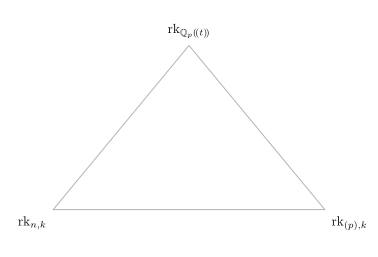
Iwasawa rank triangle
- \operatorname{rk}_{\mathbb{Q}_p(\!(t)\!)} \in \mathbb{P}(\Lambda) since \mathbb{Z}_p[\![t]\!] \subset \mathbb{Q}_p(\!(t)\!).
- For A \in \operatorname{Mat}(\Lambda), n \geq 0 and k \geq 1, \operatorname{rk}_{n,k}(A) = \frac{\log_p|\operatorname{im}(A) \pmod{(p^k,\omega_n)}|}{kp^n}\,.
- \Lambda_{(p)} is a DVR. For A \in \operatorname{Mat}_{r\times s}(\Lambda) and k \geq 1, \operatorname{rk}_{(p),k}(A) = \frac{\mathrm{len}_{\Lambda_{(p)}}(A(\Lambda_{(p)}/(p^k))^s)}{k}\,.
Convergence inside \mathbb{P}(\Lambda)
- On \mathbb{P}(\Lambda):
- \operatorname{rk}_{(p),k} \to \operatorname{rk}_{\mathbb{Q}_p(\!(t)\!)} as k \to \infty
- \operatorname{rk}_{n,k} \to \operatorname{rk}_{(p),k} as n \to \infty
- \operatorname{rk}_{n,k} \to \operatorname{rk}_{\mathbb{Q}_p(\!(t)\!)} as n\,, k \to \infty.
The Iwasawa rank triangle
Let A\in\operatorname{Mat}_{r\times s}(\Lambda) and M=\operatorname{coker}(A)=\Lambda^r/A\Lambda^s. Assume M is torsion and M/\omega_nM is finite for n\gg0.
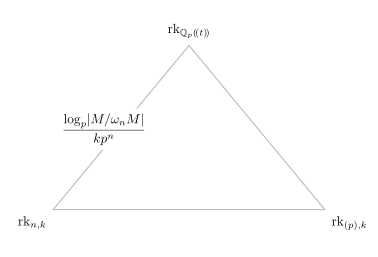
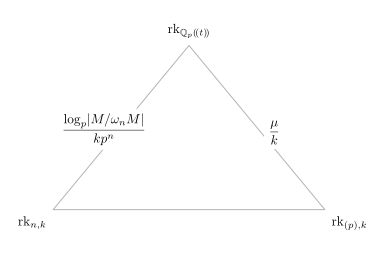
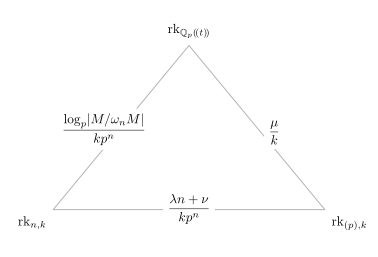
(S., 2026) The triangle equality is
\boxed{ \frac{\log_p|M/\omega_nM|}{kp^n} = \frac{\mu}{k} + \frac{\lambda n+\nu}{kp^n} }
Equivalently,
\boxed{ \log_p|M/\omega_nM| = \mu p^n+\lambda n+\nu }
For the Iwasawa module of the tower this becomes (🤨)
\boxed{ v_p\!\left(h(F_n)\right) =\mu p^n+\lambda n+\nu. }
Thank you
Questions?
How big is your matrix?
Depends who you ask…